
The shopping-centre investment intelligence ecosystem
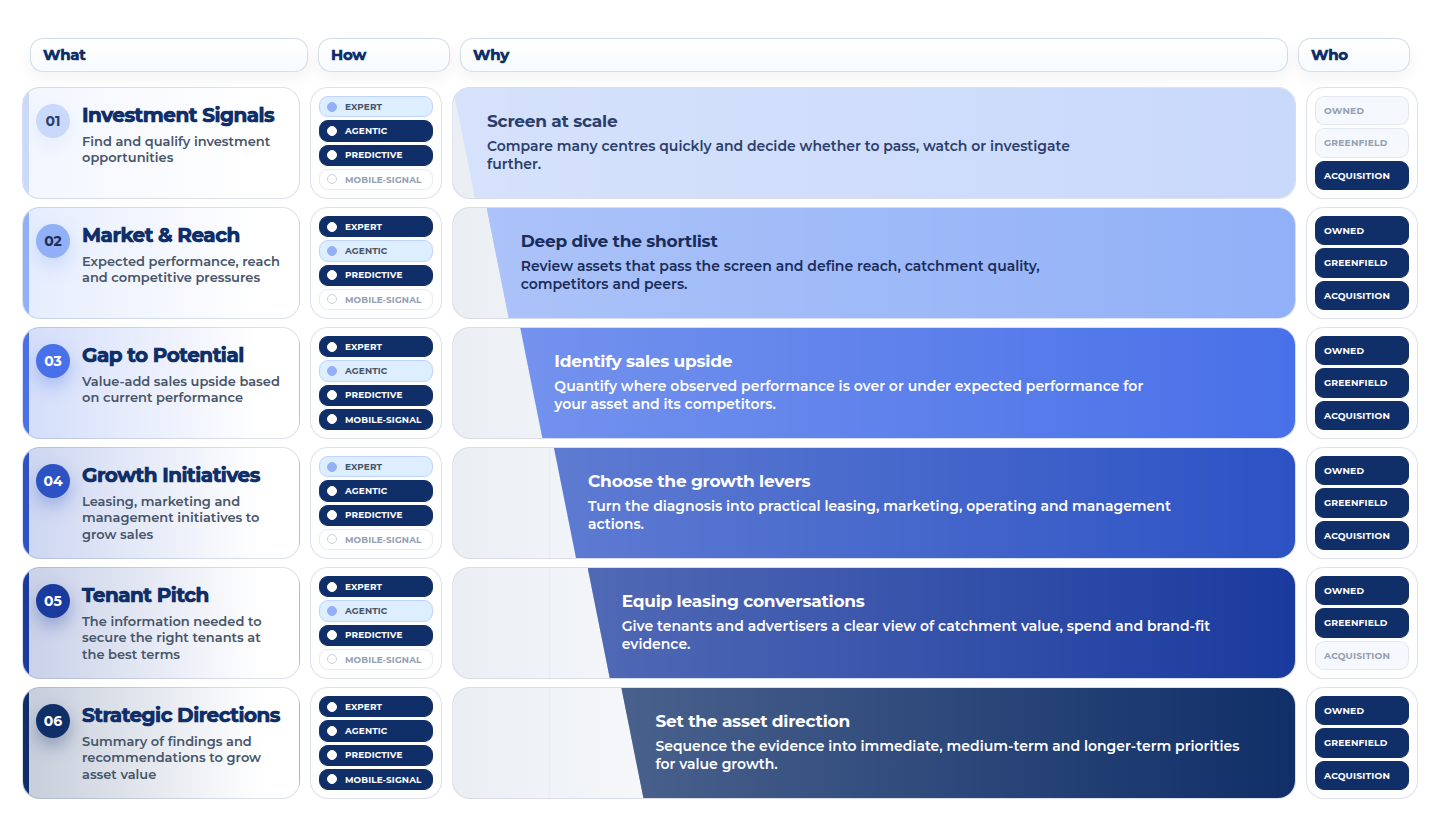
LoculInvestor connects national screening, paid Investment Signals, deeper report modules and online delivery so investors can compare assets, qualify opportunities and decide where deeper work is warranted.
Packages define which report stages are included. The online portal keeps reports, maps, dashboard views and supporting notes available for the team.
Quantify the upside
Size the gap to potential in sales and value terms.
Diagnose the cause
See which suburbs, customers, and competitors drive the gap.
Prioritise action
Get the next best moves for leasing, remix, marketing and development.

Follow the evidence as the investment lifecycle progresses.
The National Scan shows the centres we have indexed. Basic dots show centre name and GLA; buying Investment Signals unlocks the first report, and any missing Australian shopping centre can be requested.
1. Scan the national marketUse the National Scan to browse indexed centres and choose which ones to purchase or request. |
2. Buy the first signalPurchase Investment Signals for a centre to unlock the first layer of analysis on the scan. |
3. Add the evidenceAdd report stages as the investment lifecycle progresses and the commercial questions become more specific. |
4. Put the evidence to workReview each report online and brief the team on the evidence behind the next move. |
Too many disconnected inputs.
No single view of the opportunity.
Hard to know which move creates value first.
National scan first. Six reports as the evidence deepens.
The scan is the market-wide shopfront. Grey dots carry basic centre details only. Purchase Investment Signals for a centre to unlock first-pass analysis, then add deeper reports when the decision needs more evidence.
How much upside is available?
Model the centre’s potential, estimate the sales gap and show the value opportunity in commercial terms.
Why is the centre not capturing it today?
Diagnose gaps across geography, customer segments, competitors, retail categories and visit behaviour.
What should happen next to grow asset value?
Prescriptive analytics describe the actions needed to close the gap to potential.
How the LoculInvestor platform fits together.
The National Scan shows indexed centres and requestable opportunities. Investment Signals unlocks the first paid analysis; deeper reports add the evidence needed by investment, board and asset teams.
|
Starting point
The National Investment ScanBrowse indexed centres, see basic name and GLA, and choose which assets to purchase or request. Think: where should we look first? |
Report stages
The evidence modulesInvestment Signals unlocks the first analysis. Deeper reports add proof as the decision gets sharper. Think: what analysis answers the question? |
Packages
The buying optionsBuy one centre, a shortlist, or the next report depth for a live asset. Think: which scope fits this decision? |
Online portal
The delivery workspaceReports, maps, dashboard views and notes are delivered online for the investment, board and asset teams. Think: where do we review the evidence? |
Customers, not residents.
Understand who actually visits and competes for the asset, not just who lives inside a drawn boundary.
Prescriptive, not descriptive.
Move from metrics to leasing, remix, capex and acquisition decisions the asset team can execute.
Owned, acquisition or greenfield.
Analyse owned centres, competitors, acquisitions and greenfield without permission or restriction.
Decision impact per dollar.
Get investment-grade direction without paying for data, dashboards or restrictions that do not improve the decision.
Choose the report scope that matches the decision.
Start by purchasing Investment Signals for a centre or shortlist, then add the report package that matches the decision. Indicative pricing below is for neighbourhood centres.
|
|
|
All prices exclude GST. Due Diligence and Strategic Asset Plan pricing varies by asset class, complexity and portfolio scope. Volume discounts may apply.
1
Model market potential.
Define the trade area and expected performance baseline for the centre.
3
Diagnose the gap.
Show where and why the gap exists across geography, life-stage and competition.
2
Measure actual performance.
Compare observed customer behaviour against what the centre should capture.
4
Recommend the moves.
Sequence the actions that will close the gap and grow value.
Built for shopping centre analytics by industry experts.
Retail property focus.
Designed for owners, investors, developers and asset managers at every stage of the investment lifecycle.
AI-driven, expert curated.
Uses machine learning and agentic AI to transform open source data and mobile signals, into actionable intelligence.
Prescriptive output.
Focused on generating value by turning analysis into leasing, marketing, development and repositioning actions.
RECOMMENDED VIEWING ORDER
1
Strategic Asset Plan
A one-page summary: lost sales quantified, priorities sequenced and risks mapped.
2
Executive Report
The management read: evidence and commercial logic in 6–10 pages.
3
Full Analysis
The supporting evidence library for teams who want to go deeper.
START WITH THE ANSWER
Strategic Asset Plan
The one-page decision summary. It gives owners, investors and managers the commercial answer before they open the detailed report.
Opportunity Quantified
Size the gap to potential in sales and customer engagement terms.
Priorities Sequenced
Show which moves matter first and why.
Actions Mapped
Connect recommendations to leasing, remix, marketing and development.
THE MANAGEMENT READ
Executive Report
A concise report for owners, managers and investment committees. It explains the evidence, the commercial logic and the recommended strategy without requiring the reader to explore every dashboard.
Executive summary
The headline opportunity, risk and recommended direction.
Competitor performance
Who is winning share, where, and why.
Market potential
What the centre should be able to capture from its trade area.
Opportunity breakdown
Which customers, suburbs and retail categories matter most.
Performance gap
Where observed behaviour falls short of expected performance.
Recommendations
The actions, sequence and rationale to grow value.
THE SUPPORTING EVIDENCE
Full Analysis
The evidence library behind the asset plan. Each chapter answers a commercial question and supports the recommended strategy.
Outcomes
Analysis distilled into a clear summary and recommendations
Executive summary
The commercial answer upfront: opportunity, risks and recommended direction.
Introduction
The asset context, report scope and evidence base for the analysis.
Recommendations
The priority actions to close the gap and grow asset value.
Potential
What should the centre be capturing from its trade area?
Trade area
Defines the customers and geography the centre should be capturing.
Battlegrounds
Shows where the centre and competitors compete for customers and which areas are most contestable.
Customer segments
Profiles the customer groups driving demand, spend and opportunity.
Peer centres
Benchmarks the asset against comparable centres to understand how other assets operate under similar trading conditions.
Playbook
How can you better meet your customers' needs?
Future Considerations
Identifies the external risks, tailwinds, and market changes that could affect an asset’s future performance.
Voice of the customer
Reveals what shoppers value, expect and dislike about the asset, its tenants and its competitors.
Retail mix optimisation
Profiles the asset and its competitors' tenants to identify moves that will better match local demand.
Positioning
The tools to execute the strategy and win tenants.
Trade area report
Packages the residential catchment story for tenants.
Addressable market
Quantifies and benchmarks the customer spending power by segment and category.
Destination tenants
Identifies tenants that can create trips beyond normal customer behaviour.
Performance
How are customers behaving and where are sales being lost?
Lost sales
Quantifies where customer behaviour falls short of potential.
Same-day neighbour visits
Shows which nearby destinations customers combine in the same trip.

Found a centre worth a closer look?
Tell us the asset and the decision. We will scope Investment Signals, a shortlist, the next report stage, or any Australian shopping centre missing from the map.
Book a walkthrough Open National Scan Request centre/report