
Show retailers where a site can reach customers and trade with confidence.
LoculReach reports turn demand, competition and portfolio-fit evidence into a clear site story for retailers. Use them to test whether a location deserves pursuit or compare a target site against the brand’s existing network.
Rank the opportunity
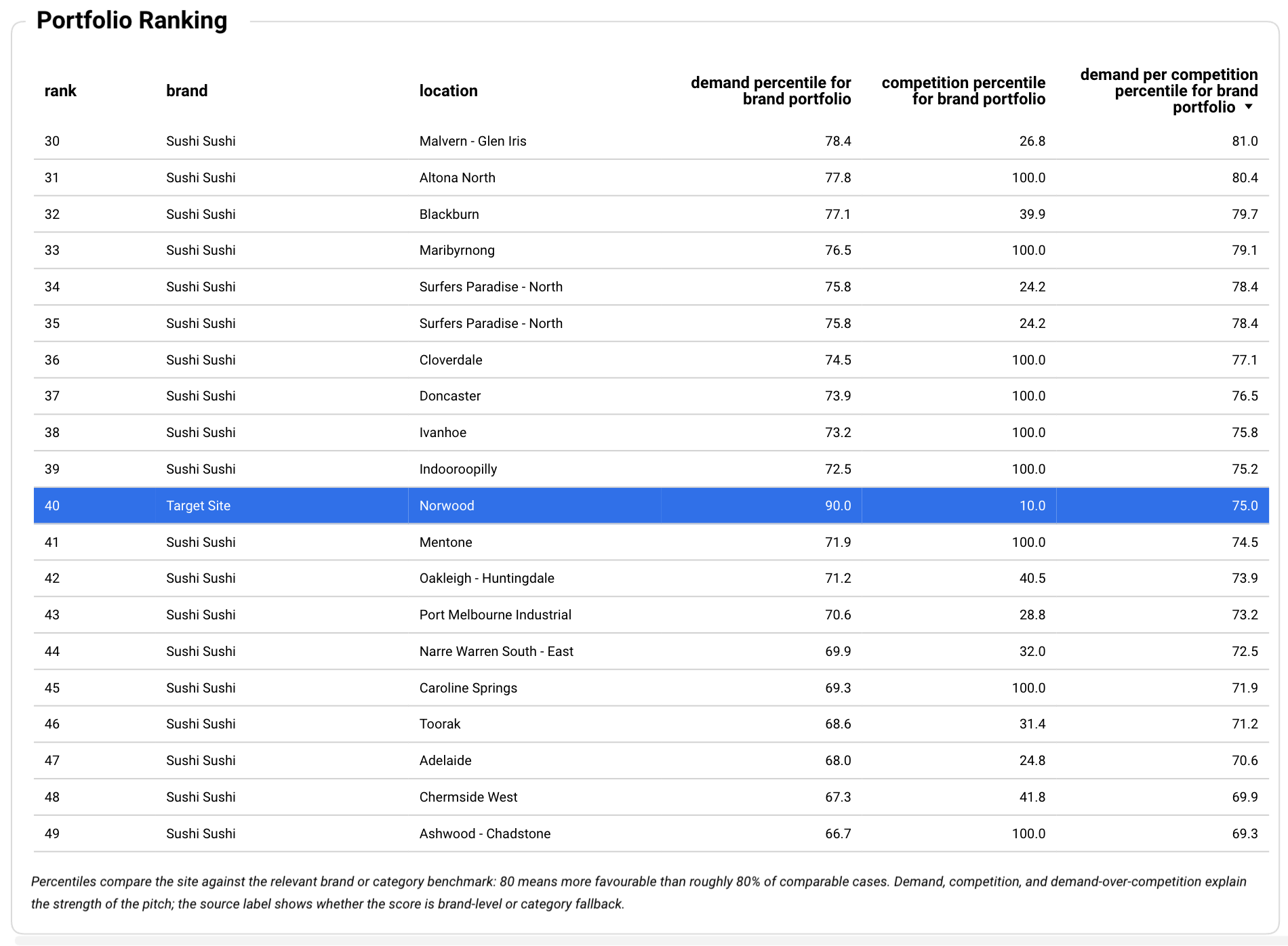
Compare a target site against the brand portfolio using demand, competition and demand-over-competition evidence.
Explain the market
Show the catchment, customer missions, surrounding competitors and practical site signals behind the recommendation.
Support the decision
Give retailers a report that explains whether the location deserves pursuit, negotiation or pause.
Built for brand-specific retail site decisions.
LoculReach reports help teams judge one location against the brand, the market and the competitive set. The output is designed for a real decision, not a generic catchment profile.
Retailer site decisions
Help network, property and leadership teams decide whether a specific site fits the brand and has enough reachable demand.
Retailer opportunity story
Turn a retail opportunity into a clearer brand-specific story backed by demand and competitive evidence.
Portfolio benchmarking
Compare the target site with relevant existing locations so the recommendation is grounded in familiar trading environments.
Every LoculReach report answers three commercial questions.
The report moves from the size of the market to the quality of the opportunity and the strength of the brand fit.
Is the demand strong enough?
Measure the local customer, worker and spend signals that matter for the brand and format.
Is the competitive position attractive?
Separate high-demand sites with heavy competition from opportunities where the brand has more room to trade.
How does it rank against the portfolio?
Place the target site beside comparable brand or category locations so the team can see whether it is an outlier, average or strong candidate.
Choose the report depth the decision needs.
Start with a focused site report, or choose the full customer-view package when the opportunity needs deeper movement, engagement and addressable-market evidence. Pricing is consistent across sites.
Reach Essentials
Site ranking + brand pitch + reachable market
All sites
$1,350 + GST
Consistent price for each LoculReach Essentials report
A focused LoculReach report for teams who need to know whether the site fits the brand, how it ranks against relevant benchmarks and how to explain the opportunity.
Customer 360
Full customer view + movement evidence
All sites
$2,450 + GST
Consistent price for each LoculReach Customer 360 report
The full package for higher-value opportunities: site ranking plus mobile signal-derived addressable market, customer engagement and observed movement evidence behind the recommendation.
Report evidence retailers can understand quickly.
LoculReach combines retail property judgement with demand, movement, competitive and portfolio evidence, then presents the result as a decision-ready report.
Portfolio ranking
A clear benchmark of the target site against brand or category locations, including demand and competition percentiles.
Catchment and customer evidence
Resident, worker, visitor, spend and movement signals that explain who the site can realistically reach.
Competitive context
Nearby brands, substitutes, co-tenancy and local market structure translated into a practical opportunity read.
Outputs designed to promote a site with evidence.
The output gives the team a clear site story, a defensible benchmark and the evidence behind the recommendation.
Online report
A shareable LoculReach report with the evidence, visuals and recommendation in one place.
Executive narrative
A concise explanation of why the site does or does not make sense for the brand.
Decision support
The ranking, assumptions and caveats needed to pursue, qualify, negotiate or reject the opportunity.
Promote the site with a report the retailer can act on.
Use LoculReach to show how the target site ranks, who it can reach and why the opportunity deserves attention.
Loculyze for Retail Leasing

We turn privacy-compliant mobile location signals into decision-ready metrics.
You get investment-grade insights based on observed visitor behaviour over the last 12-months — highly-recent and ready for your next pitch.
-
Quantify any site, anywhere: Rapidly size the opportunity for any building, pitch, or precinct across Australia using recent, observed visitation.
-
One score to compare sites: Communicate performance clear engement metrics summarised by our loculAI Score so any lease can be benchmarked at a glance.
-
Momentum made visible: Time-series trends plus time-of-day and day-of-week engagement patterns.
-
True trade areas: Map reach by suburb and segment visits by short walk, local, regional, interstate, and international visitors.
-
Tenant-ready market sizing: Tailor the addressable market to a brand’s categories and target customer.
-
Prove adjacency power: Demonstrate complementary uses and multi-store strategies.
-
Know the audience: Segment and profile who visits — and the quality of their engagement.